A complex asset enters service.
Its engineering documentation has been accepted. Its maintenance program has been developed. Its spares have been identified. Its technical publications are available. Its support arrangements are in place.
On paper, everything is complete.
Then the asset changes, as every asset does. A component is modified. A failure mode shows up that design never anticipated. A maintenance interval is revised. A supplier goes obsolete. An operating condition shifts. An engineering modification is approved.
Each organisation updates the information it owns. Engineering updates the design. Maintenance updates its procedures. Supply updates its inventory. Operations adjusts its processes.
Everyone does their job.
But the relationships between those updates are not necessarily maintained. The organisation now has more current information in more places, and a weaker integrated understanding of the system than it had before.
That raises the real question:
What is the value of engineering information if the relationships between that information cannot be maintained across the lifecycle?
Where This Sits in the Argument So Far
This is the third article in a short series on Integrated Product Support.
The first, IPS Is Not the Evolution of ILS. It’s the Evolution of System Responsibility, argued that a system cannot be engineered separately from the enabling systems needed to operate, support, sustain, modify and recover it. Systems engineering has to treat those enabling systems as part of the architecture, not a downstream add-on.
The second, The LSAR Was Never Meant to Become a Static Archive, argued that the LSAR loses most of its value the moment it is treated as a delivered artefact, rather than a living description of how the system is actually supported.
This article takes the next step. Integrated Product Support should not be judged mainly by the number or completeness of the support products it delivers. Its deeper value lies in maintaining continuity between engineering knowledge, configuration, operational evidence, support decisions and lifecycle outcomes.
That is a systems engineering problem before it is an information management one. The difference is worth stating precisely, because the two are confused constantly.
Why This Is Systems Engineering’s Job
Systems engineering is concerned with the relationships between stakeholder needs, requirements, functions, architecture, physical configuration, interfaces, operating environments, enabling systems, verification and lifecycle performance.
Those relationships exist to support engineering decisions. And they have to stay meaningful long after acquisition and initial acceptance, because the system’s configuration, operating environment and support requirements keep changing after that point, not before it.
ISO/IEC/IEEE 15288 recognises this explicitly. Among its technical management processes are information management and configuration management, defined as lifecycle processes rather than acquisition activities. The standard’s intent is that the information needed to make decisions stays available, accurate and relevant across the whole life of the system, not just until the design review.
So systems engineering cannot be understood as merely the process that sets the initial technical baseline. The relationships established during development have to stay traceable and usable as the system evolves.
IPS extends that responsibility into the support and sustainment environment. It is what connects engineering decisions to the practical resources, processes and organisations that keep capability running.
IPS is not a replacement for systems engineering. It is the integrated lifecycle discipline that translates system design and engineering knowledge into sustained operational capability, over years the original design team may not even be around for.
Information Continuity Is Not Data Availability
This is where most of the real difference lies. Organisations routinely assume their information is well managed simply because it is stored and retrievable.
An organisation can hold engineering drawings, requirements databases, configuration records, reliability analyses, maintenance plans, LSAR data, technical publications, spares catalogues, ERP and EAM records, operational performance reports and FRACAS data, and still not have continuity.
A document can be current in its own repository while the assumptions and relationships connecting it to other engineering information have quietly gone stale.
A maintenance task can be current in the maintenance management system while no longer reflecting the latest equipment configuration.
A reliability prediction can stay available while no longer describing actual operating conditions.
A spare part can be correctly catalogued while no longer applying to the configuration it is catalogued against.
The problem, in other words, is rarely missing information. It is whether the information that exists stays technically consistent, traceable and relevant to the system actually being operated.
Three distinct things are worth separating:
- Data availability: the information exists and can be retrieved.
- Data quality: the information is accurate, complete and fit for its intended use.
- Information continuity: the relationships, assumptions, configuration applicability and decision context stay connected and usable across lifecycle changes.
Each is necessary, and none implies the next. Data quality has its own international standard in the ISO 8000 series, and organisations increasingly measure it. Continuity is much less often measured, because it is a property of the connections between records rather than of any one record.
Information science offers a useful frame. The classic hierarchy described by Russell Ackoff and others runs from data, to information, to knowledge. Data becomes information when it is given context, and information becomes knowledge when it is connected to understanding and action. Information continuity is, in effect, the preservation of the step from information to knowledge. Without it, an organisation keeps its data and loses its understanding.
Information continuity does not guarantee perfect data or correct decisions. What it provides is a much stronger basis for making and assuring those decisions than data availability alone ever can.
The Relationships Are Worth More Than the Records
A short example makes this concrete.
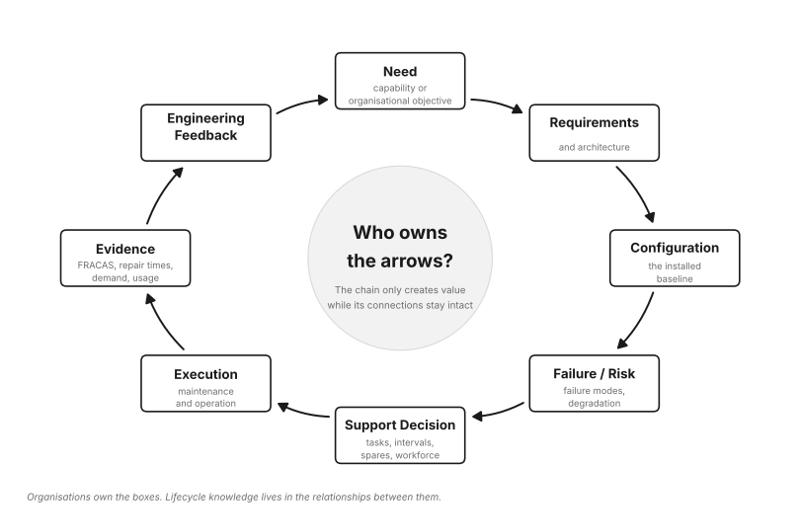
A pump performs a required function. Its design determines its operating characteristics and failure behaviour. Failure analysis identifies its failure modes and their consequences. Maintenance analysis turns those into preventive or corrective tasks. Those tasks create requirements for personnel, skills, tools, test equipment, spares, technical instructions, facilities and time.
Now the pump is modified.
The engineering change may affect several of those relationships at once. If the change is reflected only in the drawing and the configuration record, the organisation now has an updated design and an out-of-date support model. Quietly, two different versions of the same system are in circulation.
The real engineering value was never simply knowing that the pump changed. It was knowing what that change means for everything needed to operate and sustain it.
That is information continuity, stated in entirely practical terms.
The technical community has tried to formalise exactly this. ISO 10303-239, known as Product Life Cycle Support (PLCS), was developed specifically to represent a product’s information across its whole life: not just its design, but its support requirements, maintenance activities, configuration changes and in-service history, linked together in one information model. Its existence is a recognition that the relationships, not the documents, are what need to be exchanged and preserved.
Where Continuity Actually Breaks
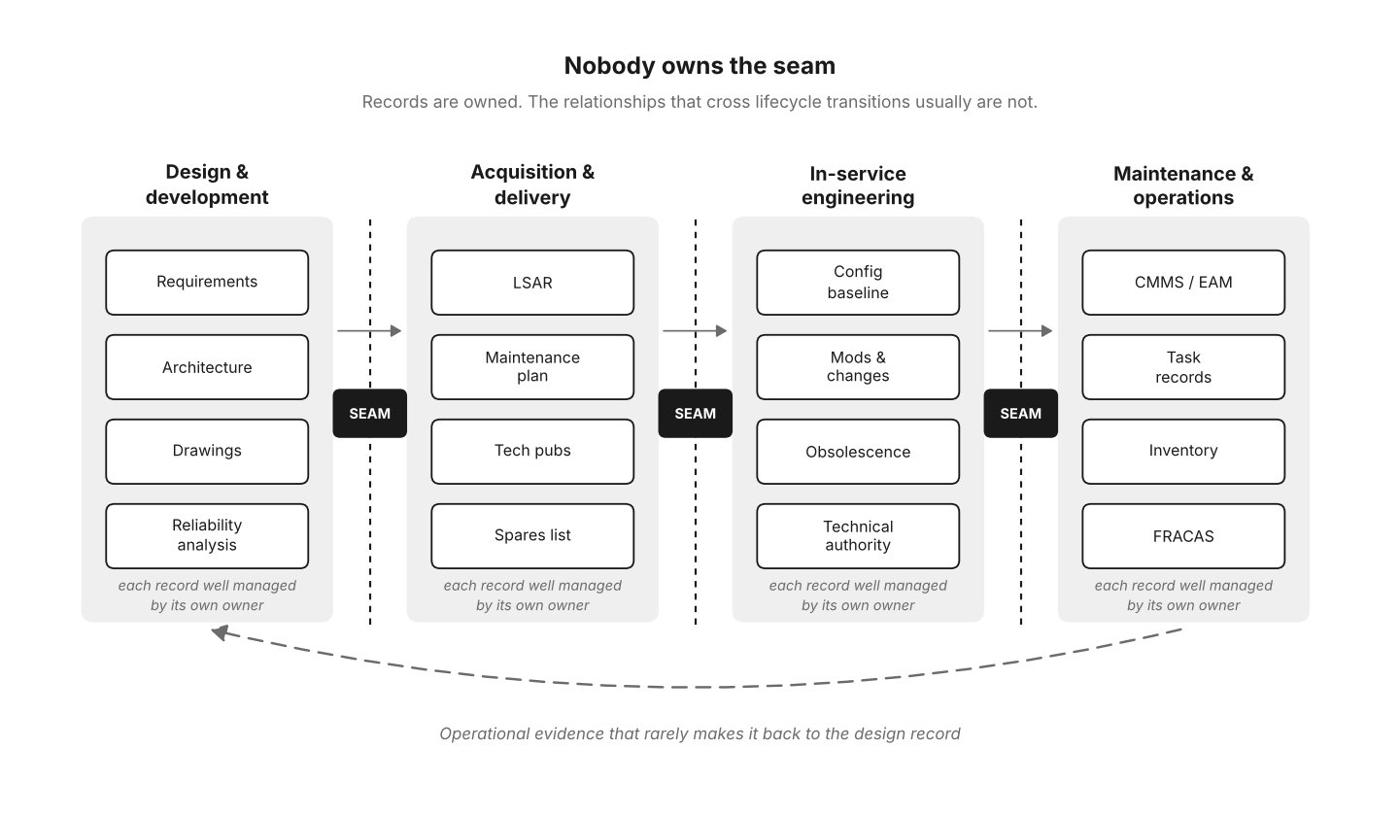
This is not a competence problem, and it is not any one discipline’s fault. It is structural, and it tends to break at predictable lifecycle transitions:
- Development to acquisition, where different contractors build engineering analyses on different information structures.
- Acquisition to sustainment, where the operating organisation inherits information without the analytical context behind it.
- Engineering to maintenance, where design modifications do not propagate consistently into tasks, tools, training and technical instructions.
- Maintenance to engineering, where operational experience and failure data are not systematically fed back into the design record.
- Contractor to asset owner, where information is delivered without clear ownership or a way to keep it current.
- System upgrade to ongoing operation, where the physical configuration moves ahead of the support information, workforce capability or facilities meant to sustain it.
[Insert diagram: ips-information-seams.jpg]
What these have in common is that responsibility, information systems and contractual boundaries rarely line up with the actual flow of engineering decisions.
Nobody owns the seam.
The information on each side of it may be perfectly well managed by its own owner, and the two sides can still drift apart.
Organisational research explains why these seams are so hard to cross. Paul Carlile’s work on knowledge boundaries identified three types. At a syntactic boundary, the problem is a lack of shared formats, which better data exchange can solve. At a semantic boundary, the same term means different things to different groups. At a pragmatic boundary, the groups have different interests, and sharing knowledge means someone has to change what they do. Lifecycle transitions usually involve all three. A handover package can solve the syntactic problem completely and leave the other two untouched.
Susan Leigh Star and James Griesemer offered a related idea: boundary objects, artefacts flexible enough to be used by different communities while keeping a common identity across them. Well-designed support products can work this way. A properly structured LSAR, for example, can be read by an engineer, a maintainer and a supply planner, each for their own purpose, while still describing one system. When those products are treated as deliverables to be signed off rather than shared objects to be maintained, they stop working as boundary objects and become records of one community’s view at one point in time.
Why This Is Universal, Not Defence-Specific
Every asset-intensive industry runs the same relay, whatever it calls the handoffs: design to operations, OEM to operator, capital project to sustaining engineering, commissioning to steady-state maintenance.
A mining operation, an airline, a utility or a rail operator can each have excellent individual systems, such as CMMS, EAM, PLM and reliability databases, and still lose continuity at exactly these transitions, for exactly this reason.
The fix is not a single master database. It rarely is. Digital thread initiatives and integrated platforms can certainly help, by making relationships easier to record and follow. But a connected platform with no one responsible for keeping its connections true is just a faster way to propagate stale information.
The fix is making someone accountable for the relationships that cross the seams, not just the records that sit on either side of them.
The Leadership Question
That makes this, ultimately, a governance question rather than a tooling one.
The question is not:
Do we have the information?
It is:
Can we trace what an engineering decision today means for everyone who will have to act on its consequences tomorrow?
If the answer depends on someone remembering to tell the right person, continuity does not exist. Only good intentions do.
In practice, governing continuity tends to mean a few concrete things:
- defining which information is authoritative for each relationship;
- assigning an owner to each important cross-boundary relationship, not just to each repository;
- setting the events that must trigger reassessment, such as a configuration change, a new failure mode or a revised interval;
- building handover requirements around analytical context and rationale, not just data delivery; and
- making sure operational evidence has a defined path back into the engineering baseline.
None of these needs new technology. All of them need someone whose job it is.
The Products Were Never the Point
Integrated Product Support, done well, is the discipline that makes that traceability someone’s job rather than everyone’s assumption.
Its products, the LSAR, the maintenance plan and the technical publications, are evidence that the work has been done.
They were never the point of the work itself.
The point was, and still is, keeping the relationships between engineering decisions intact long enough for the system to still make sense by the time someone has to act on them.
Aerion Engineering Advisory
Aerion Engineering Advisory helps organisations maintain the continuity of engineering and support information across the asset lifecycle.
Our approach connects systems engineering, Integrated Product Support, LSAR, configuration management, RAM, maintenance analysis and operational evidence. We help organisations identify where continuity breaks at lifecycle transitions, assign ownership of the relationships that cross them, and keep support information aligned with the system actually being operated.