When a significant performance problem emerges, organisations naturally look for its source.
Engineering failed to anticipate the issue.
Operations did not follow the intended process.
Maintenance failed to prevent the downtime.
Procurement selected the wrong solution.
The reliability assumptions were inaccurate.
Project management accepted too much risk.
These explanations are attractive because they simplify complexity. They establish accountability and suggest that correcting one function will correct the problem. Sometimes that is exactly what is needed.
But complex systems rarely fail in ways that match an organisation chart.
In many cases, the teams involved are competent. Their individual decisions are reasonable. Established processes have been followed, requirements met, reviews completed and risks assessed.
Yet operational performance still falls short.
The reason may not lie within any one function. It may lie between them.
Organisations Have Boundaries. Systems Do Not.
Specialisation is necessary in complex engineering organisations. Systems engineering, design, reliability, Integrated Product Support, maintenance, operations, procurement, commercial management and project management each need different expertise. Dividing responsibility lets each discipline build the depth it needs to do its job well.
But the engineered system does not recognise those organisational boundaries.
Availability does not belong only to reliability engineering.
Maintainability does not belong only to maintenance.
Lifecycle cost does not belong only to finance.
Operational effectiveness does not belong only to operations.
Systems engineering has a precise term for this. INCOSE defines a system partly by its emergent properties: behaviours that arise from the interaction of its elements and cannot be found in any element alone. Availability, maintainability and lifecycle cost are emergent properties in exactly this sense. They are produced by decisions made across many disciplines and throughout the lifecycle.
A design decision can influence maintenance.
A procurement decision can influence reliability and obsolescence.
An operational decision can alter failure behaviour.
A schedule decision can reduce verification confidence.
A commercial decision can constrain future engineering options.
The organisation divides these decisions between functions. The system experiences their combined effect.
Good Teams Can Still Produce Poor System Outcomes
This creates an apparent contradiction.
A design team may meet its technical requirements. Procurement may secure a commercially attractive solution. Reliability engineers may produce credible predictions from the evidence available. Maintenance planners may develop a technically sound program. Operations may follow approved procedures. Project management may deliver against agreed milestones.
Each function can show that it has performed well. And the capability can still underperform.
This is not necessarily evidence of incompetence. It can be evidence that the organisation has optimised individual functions without properly managing how they interact.
Local success does not automatically create system success.
The Problem Often Exists at the Interface
Consider a maintenance concept developed during acquisition.
The analysis may be technically sound. Tasks are defined, intervals justified and resource requirements documented.
Once the system enters service, however, operating conditions reveal constraints that were not properly represented during planning. Access is harder than assumed. Maintenance windows are shorter. Operational tempo is higher. The required personnel are not always available. Environmental conditions accelerate degradation.
The maintenance analysis itself may not have been wrong. The problem sat at the interface between engineering assumptions and operational reality.
The same pattern can occur in procurement. A component may meet technical requirements and offer attractive acquisition economics. Years later, sustainment is dealing with extended lead times, obsolescence, specialised tooling or dependence on a constrained supplier. The procurement decision may have been rational within its original boundary. The lifecycle consequence emerged somewhere else.
These are not isolated functional failures. They are system interaction failures.
The sociologist Charles Perrow argued in Normal Accidents that the most serious failures in complex systems often arise not from a single broken component, but from unexpected interactions between components and subsystems. This is especially true where those parts are tightly coupled, so that a disturbance in one propagates quickly to others. Perrow was writing about high-risk technologies, but the insight applies equally to organisations. Functions that depend heavily on each other's assumptions are tightly coupled, whether or not the organisation chart shows it.
Every Function Holds Only Part of the System
As organisations grow larger and more specialised, knowledge becomes distributed.
Engineering understands design intent.
Reliability specialists understand predicted failure behaviour and its uncertainty.
Maintenance understands degradation, repair complexity and recurring failure patterns.
Operations understands actual usage and environmental exposure.
Supply chain teams understand lead times and material constraints.
Commercial teams understand contractual mechanisms and supplier obligations.
Project management understands schedule, cost and stakeholder pressures.
Each function holds valuable information. But each sees only part of the system.
Herbert Simon's concept of bounded rationality explains why this matters. Decision-makers act rationally, but only within the limits of the information, time and attention available to them. A function making a sound decision on partial information is not behaving irrationally. It is behaving exactly as bounded rationality predicts. The difficulty is that the missing information often sits in another function.
That creates a fundamental integration problem. The organisation must combine these partial views into a coherent understanding of system behaviour.
When that integration works, specialist knowledge strengthens decision-making. When it weakens, assumptions begin to drift apart:
Engineering believes the system will be operated one way. Operations uses it another way.
Reliability modelling assumes one maintenance regime. Maintenance carries out another because of resource constraints.
Procurement assumes an acceptable level of supply chain risk. Sustainment later experiences a different reality.
None of these discrepancies need look significant within any one function. Together, they can fundamentally change system performance.
Interface Risk Is System Risk
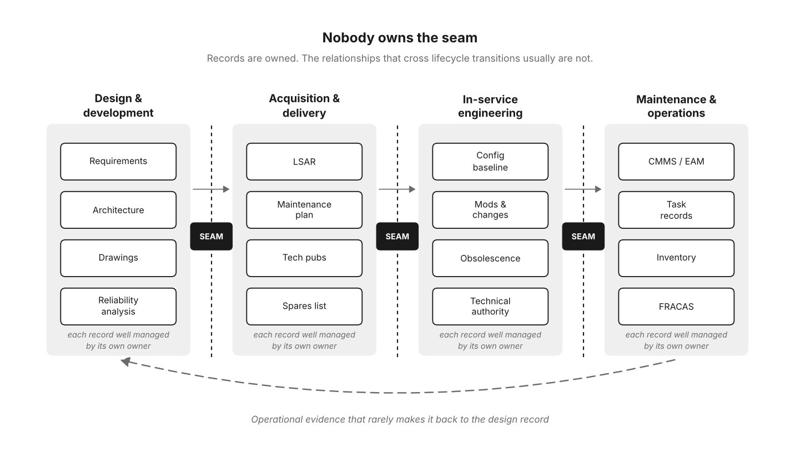
Traditional governance assigns risks to owners. This is necessary. But some of the most consequential risks don't fit comfortably within a single ownership boundary.
Who owns the risk created by the interaction between equipment accessibility and maintenance workforce constraints?
Who owns the consequence when operational utilisation invalidates reliability assumptions?
Who owns the lifecycle effect of a procurement decision that introduces future obsolescence exposure?
Who owns the interaction between design configuration, logistics delay and operational availability?
Engineering may own one part, operations another, maintenance another, and commercial management another. But the interaction itself may have no obvious owner.
Engineers already have tools for making technical interfaces visible. N² diagrams and design structure matrices map how subsystems exchange inputs and outputs, and expose dependencies that a hierarchical breakdown hides. The same logic can be applied to organisational interfaces. Mapping which functions depend on which assumptions, and who owns each dependency, often reveals that the riskiest cells in the matrix belong to no one.
This is where system-level risk becomes hard to see. Each function manages the part within its authority, while the combined exposure develops between them.
Systems Thinking Is an Integration Capability
Systems thinking is sometimes treated as an abstract engineering concept. In practice, it is a very practical management capability. It means continually asking how individual decisions interact with the wider system:
- What assumptions does this decision depend on?
- Which other functions depend on those assumptions?
- Who inherits the consequence if they prove wrong?
- What lifecycle constraint are we creating?
- What are we optimising, and what might get worse as a result?
- Where does responsibility pass from one function to another?
- Who keeps visibility of the overall outcome?
These questions push decision-makers to look beyond the immediate boundary of their function. That matters most when a decision looks locally attractive.
The question is no longer simply:
Is this a good engineering decision?
It becomes:
What does this decision do to the system?
Accountability Must Extend Beyond Individual Decisions
Accountability remains important. Poor decisions should be understood, processes improved and technical errors corrected.
But accountability based only on identifying which team made which decision can miss the more important lesson. In complex systems, outcomes often emerge from many individually reasonable decisions interacting over time.
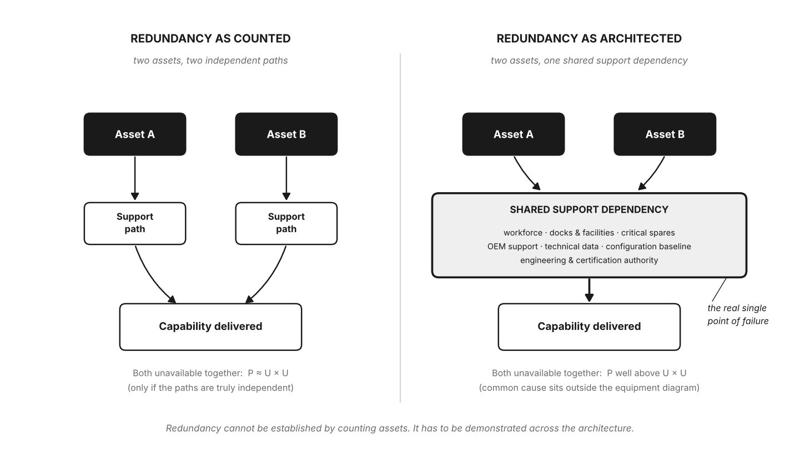
A design constraint combines with an operational requirement. That interacts with a maintenance limitation. The maintenance limitation increases logistics demand. The logistics constraint increases downtime. Eventually, the organisation has an availability problem.
Which team caused it?
That may be the wrong question.
Safety scientist Sidney Dekker has argued that asking who failed tends to produce blame, while asking how the system produced the outcome tends to produce learning. Focusing on individual error rarely explains why capable people, acting reasonably, collectively produced a poor result. The more useful question is:
How did the system of decisions create the outcome?
That does not remove accountability. It improves it. Instead of assigning responsibility only for individual actions, the organisation becomes accountable for understanding and governing the interactions between them.
System Outcomes Need System-Level Ownership
Reliability, availability, maintainability, lifecycle cost, resilience and operational effectiveness are not simply functional metrics. They are system outcomes, and they need governance that crosses functional boundaries.
That does not mean creating one organisation responsible for everything. Specialist disciplines still need clear responsibilities and technical authority. What is needed is a mechanism that brings those disciplines together around common system outcomes. That may include:
- clearly defined system-level performance objectives;
- explicit ownership of cross-functional risks;
- integrated technical and lifecycle reviews;
- shared assumptions across engineering and operational models;
- traceability between design decisions and lifecycle consequences;
- feedback from operations and sustainment into engineering; and
- decision authority able to resolve conflicts between local and system objectives.
Model-based systems engineering offers one practical route. A shared, authoritative system model makes it far harder for design, reliability and support analyses to drift onto different assumptions, because they are drawing on the same source of truth.
The objective is not organisational centralisation. It is decision integration.
Look Between the Teams
When a complex system underperforms, investigating the visible point of failure is necessary. But it should not be the end of the investigation.
The organisation should also examine the interfaces around it:
Which assumptions crossed organisational boundaries?
Where was information lost?
Which local objectives competed?
Which lifecycle consequences were passed elsewhere?
Who understood the interaction, and who had the authority to act on it?
These questions often reveal something more useful than which team was closest to the eventual failure. They reveal how the system itself was being governed.
Complex systems are rarely defeated by one isolated mistake. More often, they are shaped by interactions between many reasonable decisions, made by capable people working within different boundaries.
That is why strong systems engineering does not simply optimise the parts. It manages the relationships between them.
Organisations work in functions. Systems perform through interactions.
Aerion Engineering Advisory
Aerion Engineering Advisory helps organisations understand and manage the engineering interfaces that shape system and lifecycle performance.
Our approach connects systems engineering, RAM, FMEA/FMECA, Integrated Product Support, maintainability, operations and lifecycle analysis. We help organisations identify cross-functional risks, challenge assumptions and make sure specialist decisions add up to coherent system-level outcomes.