
In most major capital programs, almost everyone is optimising something.
Design teams optimise technical performance, configuration and delivery.
Reliability, Availability and Maintainability (RAM) specialists analyse reliability and availability performance.
FMEA and FMECA practitioners identify failure risks and their consequences.
Maintenance and RCM specialists optimise maintenance requirements.
Project teams manage cost and schedule.
Operations teams optimise asset utilisation and operational availability.
Individually, each of these activities can be rigorous, disciplined and technically sound. Yet the overall system can still underperform.
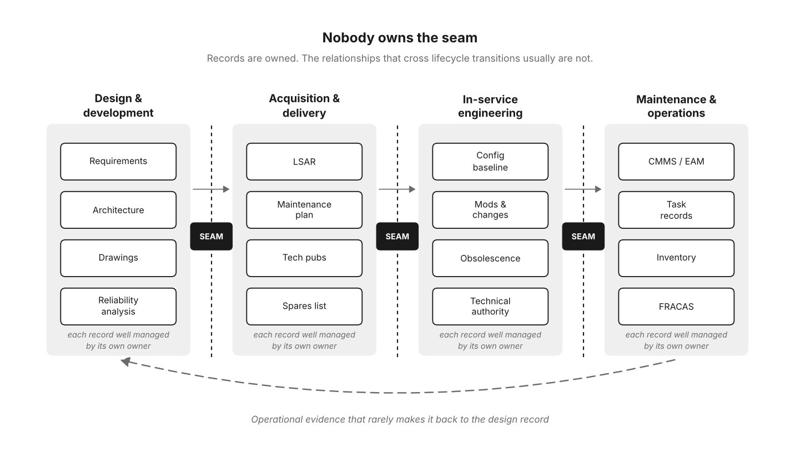
The problem is fragmented optimisation: individual functions improving outcomes within their own boundaries, without enough visibility of, or authority over, the lifecycle consequences they create elsewhere.
The organisation achieves many local optima without reaching a lifecycle optimum.
This is one of the oldest observations in systems thinking. Russell Ackoff argued repeatedly that improving the parts of a system separately does not, in general, improve the system as a whole, and can make it worse. The performance of a system depends less on how its parts perform in isolation than on how they interact. Asset-intensive organisations show this principle at scale and over long periods of time.
When Local Optimisation Creates System-Level Problems
Local optimisation is attractive because it is measurable.
A project can show that acquisition cost has been reduced.
A design team can show that weight or complexity has been reduced.
A maintenance organisation can show that scheduled maintenance hours have fallen.
Operations can show increased utilisation.
Each result looks beneficial when assessed on its own. The problem emerges when the interfaces between those decisions are examined.
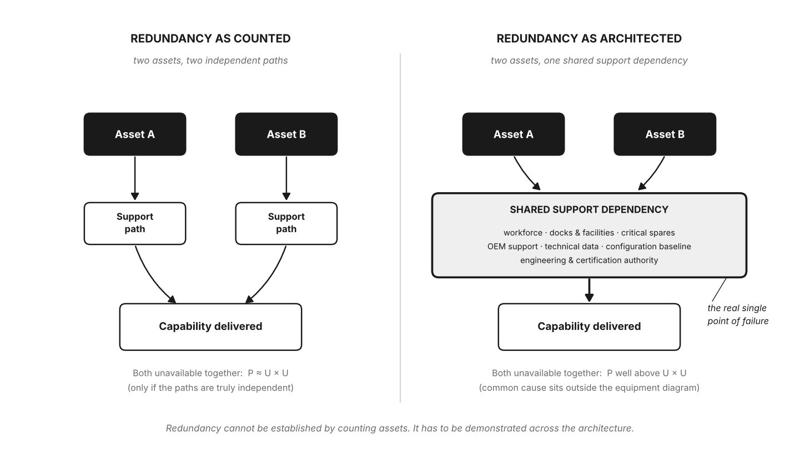
Reducing redundancy may lower acquisition cost and system complexity, while increasing the operational consequence of each individual failure.
Reducing access provisions may simplify packaging, while increasing maintenance duration for the rest of the asset's life.
Extending maintenance intervals may improve short-term availability, while increasing exposure to particular failure mechanisms.
Increasing utilisation may raise operational output, while changing failure behaviour, maintenance demand and spare parts consumption.
The individual decision may be rational. The lifecycle outcome may not be.
In optimisation terms, the organisation is solving a multi-objective problem as though it were a set of independent single-objective problems. Each function finds the best answer to its own question. But lifecycle performance sits in the trade-off space between objectives such as reliability, maintainability, cost, availability and capability. That space is only visible when the objectives are considered together.
This is why optimisation at the component, subsystem or functional level cannot be assumed to optimise the system.
Lifecycle Consequences Are Often Embedded Early
A common assumption in capital programs is that lifecycle performance can be refined step by step:
Design the asset.
Build it.
Commission it.
Hand it over.
Then optimise operations and maintenance.
But many of the variables that determine lifecycle performance are already constrained by the time the asset enters service. The systems engineering literature, notably the work of Blanchard and Fabrycky, has long distinguished between when lifecycle cost is committed and when it is incurred. A large share of through-life cost is locked in by decisions made during concept and early design, even though most of the expenditure occurs decades later in operation and support.
Equipment location affects maintainability.
System architecture affects fault tolerance and redundancy.
Component selection influences reliability and exposure to obsolescence.
Instrumentation affects diagnostic capability.
Packaging affects access and repair time.
Design standardisation affects spares holdings, training and supply chain complexity.
Operating concepts influence utilisation and maintenance demand.
These are not simply sustainment issues. They are design decisions with sustainment consequences.
That makes one word particularly dangerous in lifecycle planning:
"After."
Reliability will be addressed after concept selection.
Maintainability will be refined after detailed design.
Supportability will be optimised after commissioning.
Maintenance will resolve the issue after handover.
By the time "after" arrives, many of the economically viable options have gone.
Geometry is fixed. Interfaces are established. Capital has been committed. Contracts have been awarded. Configuration changes become steadily more expensive.
This pattern is a form of what technology studies call the Collingridge dilemma. Early in development, a system is easy to change, but its consequences are not yet well understood. Later, the consequences are clear, but change has become costly. Lifecycle engineering exists to soften that dilemma, by bringing evidence about likely consequences forward to the point where change is still affordable.
Without it, the organisation is no longer optimising. It is managing constraints created earlier in the lifecycle.
Analysis Without Decision Rights Has Limited Influence
Fragmented optimisation is not usually caused by a lack of analytical capability.
A program may have sophisticated RAM modelling, detailed FMECA, comprehensive maintenance analysis and experienced engineering teams. The more important question is:
How does that evidence influence decisions?
A RAM model that identifies an availability vulnerability provides valuable information. But if reliability evidence has little influence over configuration decisions, the vulnerability may remain.
A maintainability assessment may identify excessive repair time. But if packaging and access arrangements have already been baselined, the chance to fix the problem economically may have passed.
Lifecycle costing may show that a higher initial investment would substantially reduce through-life expenditure. But if investment approval is dominated by acquisition cost, the lifecycle optimum may still be rejected.
In each case the analysis is technically correct, yet it has no effect on the outcome. Its value depends not only on its quality but on whether it reaches a decision-maker who has both the authority and the incentive to act on it.
Analysis alone does not create integration. It must connect to decision authority.
The Governance Problem Behind the Engineering Problem
This shifts fragmented optimisation from being mainly a technical problem to being a governance problem.
Who owns lifecycle performance?
Who has the authority to challenge a configuration because of its reliability or maintainability consequences?
At what point must lifecycle cost be weighed alongside acquisition cost?
What evidence is needed before a design decision is approved?
When technical performance, acquisition cost, reliability, maintainability and operational availability conflict, who decides the trade-off?
If these questions are unresolved, integration depends largely on influence.
Reliability engineers must persuade design engineers.
Maintenance specialists must persuade project teams.
Operations must negotiate with engineering.
Asset managers must reconcile competing priorities across organisational boundaries.
Strong relationships can make this work. But relationships are not governance. They are informal, they depend on particular people, and they rarely survive changes in personnel or sustained schedule pressure.
A resilient organisation builds lifecycle considerations into the decision process itself.
Integration Must Occur at the Decision Point
True lifecycle integration does not mean inviting more disciplines to more meetings.
It means making sure the relevant lifecycle evidence exists before consequential decisions become difficult or expensive to reverse.
That may mean reliability analysis informing concept selection.
It may mean FMEA and FMECA influencing architecture and redundancy decisions.
It may mean maintainability requirements shaping equipment layout and access.
It may mean maintenance and support concepts being considered while the design is still flexible.
It may mean lifecycle cost informing capital decisions alongside acquisition expenditure.
And it means operational evidence feeding back into engineering assumptions throughout the asset's life.
In practice, this is achieved by tying lifecycle evidence to specific decision gates. Concept, preliminary and critical design reviews should each set out which reliability, maintainability and supportability evidence must be present before the gate can close. This is also the underlying intent of Logistic Support Analysis and Integrated Product Support frameworks: supportability should be an input to design decisions, not an output recorded after them.
The aim is not to give one discipline control over every decision. It is to make sure decisions are made with visibility of their consequences across the lifecycle.
From Functional KPIs to Lifecycle Outcomes
Performance measures can unintentionally reinforce fragmentation.
Projects are often measured against acquisition cost and schedule.
Engineering functions may be measured against technical compliance.
Maintenance organisations may focus on maintenance cost or schedule adherence.
Operations may prioritise utilisation or immediate availability.
Each measure has legitimate value. But when functional KPIs dominate decision-making, organisations can end up rewarding one function for transferring cost or risk to another.
A lower acquisition cost may create higher sustainment expenditure.
Higher utilisation may accelerate degradation.
Reduced maintenance expenditure may create greater operational risk.
A simplified design may increase repair duration.
From within each function, performance appears to improve. From the perspective of the asset lifecycle, value may have been destroyed.
Organisational economics describes this as a misalignment between the incentives of individual units and the objectives of the whole. Each function behaves rationally against the measures it is held to, and the organisation as a whole pays for that rationality. Lifecycle governance therefore requires measures that link functional performance to whole-system outcomes, such as through-life cost, sustained operational availability and the accuracy of lifecycle assumptions, so that cost or risk shifted between functions becomes visible instead of being rewarded.
The Cost Appears Later
One reason fragmented optimisation persists is that its consequences are usually delayed.
The design decision is made today. The consequence may not become visible for years.
It eventually appears as recurring failures, an excessive maintenance burden, poor accessibility, larger spares holdings, workforce pressure, availability shortfalls, costly engineering changes or persistent operational workarounds.
By then, the people who made the original decisions have often moved on, and the link between cause and effect is hard to trace. The organisation then tends to respond with more analysis: more dashboards, more maintenance optimisation, more reliability studies, more specialists.
Those interventions may help manage the symptoms. But the underlying problem may have been created much earlier, when separate functions were allowed to optimise decisions without an effective lifecycle framework connecting them.
Designing for the Lifecycle Optimum
Asset-intensive organisations do not necessarily need more optimisation.
They need better-integrated optimisation.
That requires specialist disciplines to keep their technical depth, while their decisions are connected through common lifecycle objectives, evidence and governance.
Reliability must influence design while the configuration is still flexible.
Maintainability must influence physical architecture before access constraints become permanent.
Operational requirements must inform engineering assumptions.
Lifecycle economics must influence investment decisions.
And operational evidence must continually challenge the assumptions set during acquisition and design.
This does not eliminate trade-offs. It makes them visible.
The goal is not to maximise reliability, minimise maintenance, minimise acquisition cost or maximise utilisation independently. The goal is to find the combination that produces the strongest outcome for the system across its intended lifecycle.
That is a fundamentally different optimisation problem.
Integration Before Optimisation
Fragmented optimisation is rarely the result of poor engineering. More often, it is the predictable result of organisational structures that divide lifecycle authority while expecting whole-of-life performance.
Individual functions can perform exceptionally well within those structures, and the overall asset can still underperform.
The answer is therefore not simply more analysis or stronger specialists. It is making sure that design, reliability, maintainability, operations, support and lifecycle economics influence decisions while those decisions can still be changed.
The most expensive lifecycle problems are often not caused by a lack of optimisation.
They are caused when each part of the organisation successfully optimises the wrong boundary.
Aerion Engineering Advisory
Aerion Engineering Advisory helps organisations connect systems engineering, RAM, FMEA/FMECA, RCM, Integrated Product Support and lifecycle analysis with the decisions that determine long-term asset performance.
Our focus is on identifying where lifecycle risk is being built in, strengthening the interfaces between specialist disciplines, and making sure engineering evidence influences decisions before constraints become costly to change.