A system can perform extremely well in a RAM model and still struggle in operation.
The predicted reliability may be strong. Calculated availability may exceed the requirement. Repair assumptions may look reasonable. The analysis may pass every formal review.
Then the system enters service.
Fault isolation takes longer than expected. Equipment is hard to access. Spares are not where they are needed. Actual operating conditions differ from the assumptions. Maintenance needs more people, tools or time than predicted. Availability starts falling below expectation.
The calculations may not have been mathematically wrong. The problem can be more fundamental:
RAM described the design rather than influencing it.
RAM Outcomes Are Created by Design
Reliability, Availability and Maintainability are usually represented as numbers: MTBF, failure rates, MTTR, availability, reliability predictions. These measures are useful. But the numbers are outputs. Behind them sit engineering decisions.
System architecture shapes redundancy and failure tolerance.
Component selection shapes failure behaviour.
Physical layout shapes accessibility.
Diagnostics shape fault isolation time.
Modularity shapes restoration.
Interfaces shape failure propagation.
Environmental protection shapes degradation.
Maintenance philosophy shapes restoration strategy.
Support arrangements shape logistics delay.
Operational profiles shape exposure.
By the time these decisions have been made, much of the system's RAM behaviour is already set. A spreadsheet can calculate their consequences.
It cannot retrospectively redesign the architecture that created them.
This was understood at the birth of reliability engineering as a discipline. The US Advisory Group on Reliability of Electronic Equipment (AGREE), reporting in 1957, framed reliability as something to be specified, allocated, designed in and demonstrated, not merely measured afterwards. The intent was always that reliability requirements would shape design. The risk is that, over time, organisations keep the calculations and lose the intent.
Timing Determines Whether RAM Influences Anything
This creates an important distinction between RAM analysis done early and RAM analysis done late.
Early RAM analysis can influence architecture, redundancy, component selection, equipment arrangement, accessibility, diagnostic capability, modularity, maintenance concepts, reliability allocation and support requirements.
Late RAM analysis can still provide valuable evidence. But its ability to influence the fundamental design keeps shrinking. Once the architecture is mature, interfaces are set and physical constraints are built in, changing the system becomes steadily more expensive.
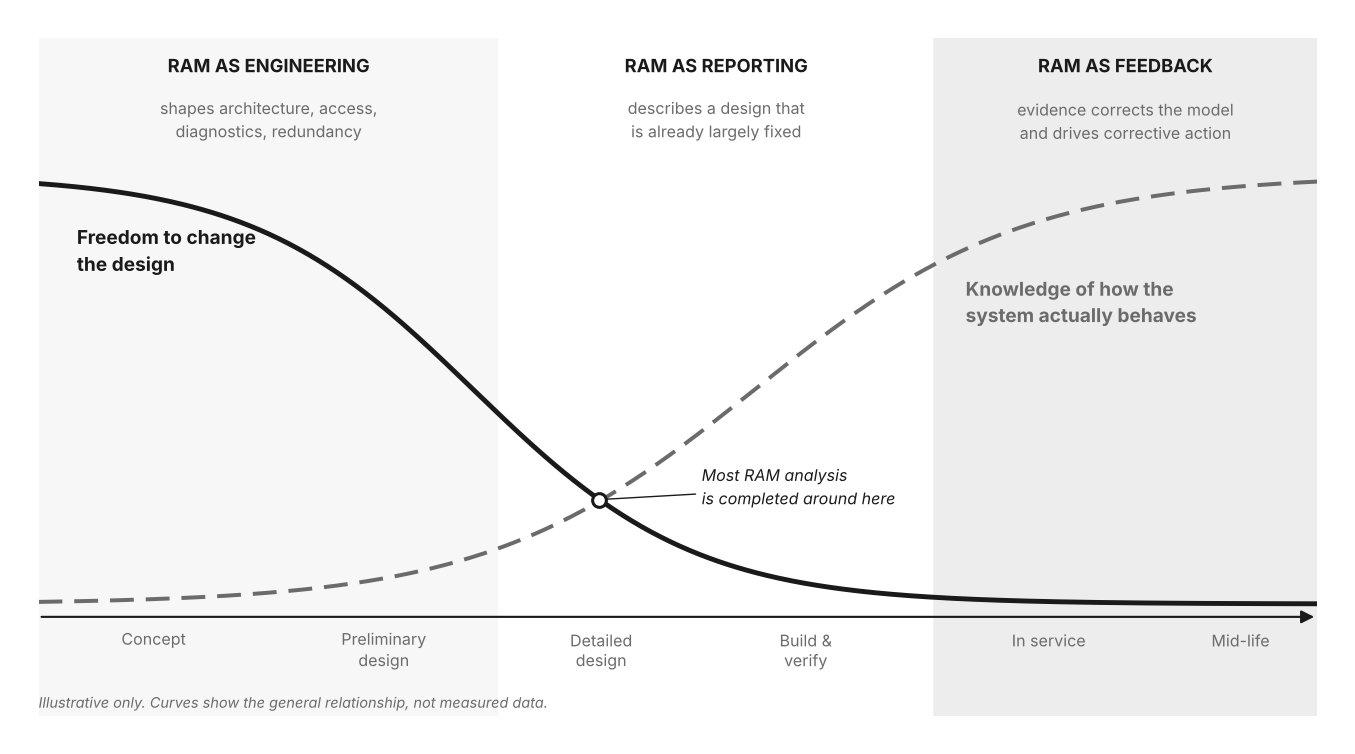
The design literature describes this as the design paradox. Early in a program, freedom to change the design is high, but knowledge about how the system will behave is low. Later, knowledge is high, but freedom has largely gone. Effective engineering is about bringing knowledge forward to the point where it can still be acted on.
[Insert diagram: ram-timing-influence.jpg]
If RAM arrives late, it risks becoming descriptive. It tells the program what performance the design is expected to achieve, rather than helping decide what the design should become.
That is the difference between RAM as engineering and RAM as reporting.
Maintainability Is Designed Into the Physical System
Maintainability provides one of the clearest examples.
A component may theoretically be replaceable in 90 minutes. That assumption may look perfectly reasonable in a model. But what happens physically?
- Can the maintainer reach it?
- What has to be removed first?
- Are structural panels blocking access?
- Do harnesses or pipework need to be disconnected?
- Can the component be lifted safely?
- Is specialist tooling needed?
- Can the fault be isolated confidently before removal?
- Can testing be done locally?
- How many people are needed?
The nominal replacement task may take 90 minutes. The actual restoration may involve hours of fault isolation, access preparation, disassembly, repair, reassembly and testing.
The MTTR assumption was not necessarily calculated wrongly.
The maintainability characteristics of the physical architecture were not well enough understood.
Human factors engineering has long provided the tools to address this. Standards such as MIL-STD-1472 set out design criteria for access openings, reach envelopes, handling weights and working postures, because maintainability depends on whether a human being can actually perform the task, not just on how long the task is assumed to take. Accessibility, diagnostics, modularity, tooling and human factors cannot be treated merely as downstream maintenance considerations.
They are design variables.
Reliability Alone Does Not Create Availability
A similar problem occurs when reliability gets disproportionate attention.
A highly reliable system can still have poor operational availability. Availability depends not only on how often failures occur, but on how effectively capability can be restored. That can involve repair time, fault isolation, spares availability, logistics delay, workforce, technical information, support equipment, facilities, engineering support and return-to-service processes.
Improving MTBF while ignoring the recovery system may produce a more reliable asset without producing the required availability.
This is why availability must be treated as a system outcome. It emerges from the interaction between the physical product and the enabling systems around it.
It also has a modelling consequence. Simple closed-form availability calculations work well when failure and repair behaviour are steady and independent. Real support systems involve queues for spares, shared maintainers, deferred maintenance and time-varying demand. Discrete-event or Monte Carlo simulation is often needed to represent how those interactions affect availability. A spreadsheet that multiplies averages can miss the effect entirely.
Assumptions Matter as Much as Calculations
Every RAM model contains assumptions: operating hours, mission duration, duty cycles, temperature, vibration, corrosion exposure, failure distributions, repair durations, logistics delay, spares availability, workforce and environmental conditions.
These assumptions define the world in which the model is valid.
Supplier reliability data may have been generated under controlled conditions. The operational system may face heat, vibration, salt, contamination, intermittent duty cycles, high utilisation, or operating profiles very different from those conditions.
The supplier data itself may be valid. Its application may not be.
Reliability prediction has a long-running debate on exactly this point. Handbook-based methods such as MIL-HDBK-217 estimate failure rates from component counts and generic stress factors. Researchers including Michael Pecht have argued that such predictions often correlate poorly with field experience, and have advocated physics-of-failure approaches that model the actual mechanisms, such as fatigue, corrosion and thermal cycling, under the actual loads. The lesson is not that handbook methods are useless. It is that a number is only as credible as the physical reasoning behind it.
A technically sophisticated model built on unrealistic assumptions simply produces a more precise description of the wrong operating environment.
RAM therefore needs continual scrutiny of both the mathematics and the assumptions underneath it.
RAM Should Challenge the Design
A useful RAM function should raise engineering questions:
- What is driving predicted unavailability?
- Which failure modes dominate?
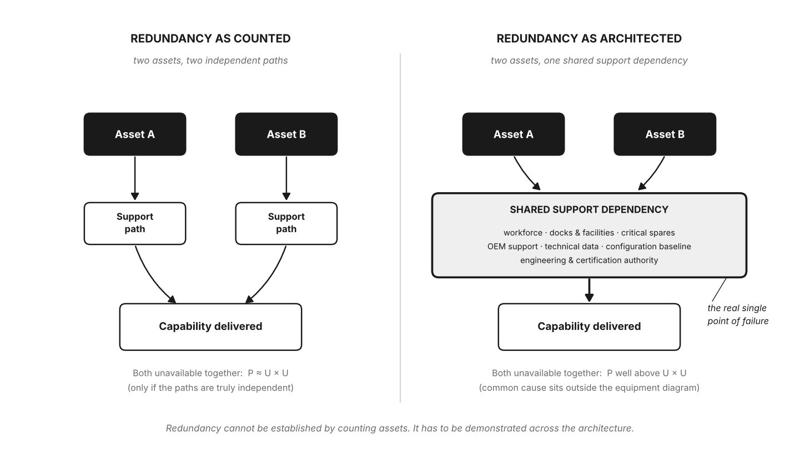
- Where are the single points of failure?
- Would redundancy materially improve mission performance?
- Which components disproportionately drive lifecycle cost?
- Can diagnostics isolate failures effectively?
- Are the repair assumptions physically achievable?
- What happens if logistics delay is twice the assumed value?
- What happens under the actual mission profile?
- Where should reliability improvement effort be concentrated?
- Which design change produces the greatest improvement?
Reliability block diagrams and fault tree analysis are the classic tools for answering several of these. An RBD shows how component reliability combines into system reliability through series and parallel paths. A fault tree works backwards from an undesired event to the combinations of failures that cause it. Used well, both reveal where the architecture is fragile. Used only to produce a compliant number, they reveal very little.
These questions turn RAM analysis into decision support. The aim is not merely to produce an availability number. It is to understand why the system behaves as predicted, and what can be changed to improve it.
Entry Into Service Does Not End RAM
Even a well-developed RAM model is still a prediction. Operation creates evidence.
Actual failure behaviour becomes visible. Actual repair durations can be measured. Actual diagnostic performance becomes known. Actual spares demand emerges. Environmental effects appear. Previously unidentified failure modes occur. Operational profiles change.
The engineering organisation can now compare predicted with observed behaviour. That should create a continuing loop:
Predict → Observe → Compare → Understand → Correct → Recalculate
If operational evidence does not return to the RAM model, the model gradually becomes historical. Its assumptions describe the system that was expected, rather than the system that now exists.
RAM therefore does not finish at Critical Design Review. Nor does it finish at acceptance.
It continues through operation.
FRACAS Closes the Engineering Loop
This is where Failure Reporting, Analysis and Corrective Action Systems become especially important.
Failure reporting alone is not enough. The purpose is not simply to build up failure records. Operational evidence needs to be analysed to determine whether:
- predicted failure behaviour is still valid;
- new failure modes are emerging;
- corrective action is needed;
- reliability allocations need reconsidering;
- maintenance strategies should change;
- spares provisioning is still appropriate; and
- availability predictions still represent operational reality.
FRACAS therefore provides more than a failure database. Properly connected to RAM engineering, it becomes part of the mechanism by which the system learns from operation.
RAM predicts.
Operation provides evidence.
FRACAS helps turn that evidence into engineering action.
RAM and Lifecycle Cost Are Connected
RAM decisions also have economic consequences.
A lower-cost component may reduce acquisition cost. But if it fails more often, needs more spares, increases maintenance labour, disrupts operations or needs replacing more frequently, its lifecycle cost may be significantly greater.
The opposite can also happen. A more expensive design solution may offer little real lifecycle benefit if the failure it addresses has limited consequence.
The aim is therefore not maximum reliability at any cost. It is appropriate system performance across the lifecycle.
Reliability allocation is where this trade-off becomes explicit. Allocation methods distribute a system-level reliability target across subsystems, weighted by factors such as complexity, criticality, technology maturity and the cost of achieving improvement. A good allocation puts reliability effort where it buys the most system performance per dollar. A poor one simply divides the target evenly and hopes.
RAM provides the engineering evidence for making those trade-offs. That means it has to interact with lifecycle cost, supportability, operational requirements and system architecture, rather than working as an isolated specialist analysis.
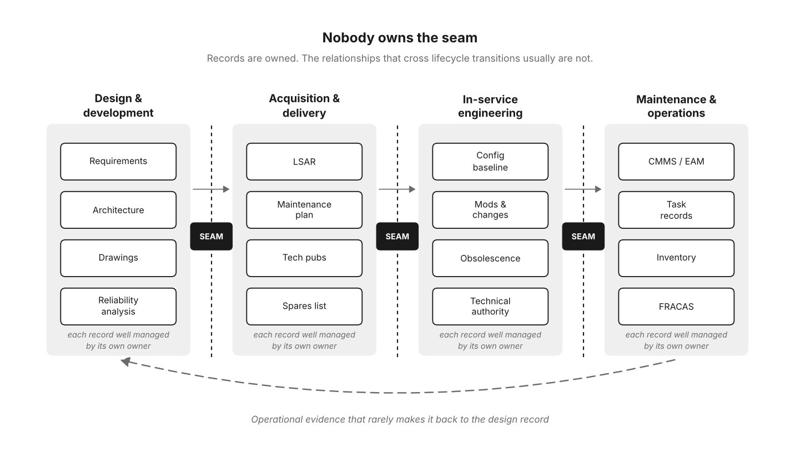
Someone Must Own the Outcome
RAM often crosses organisational boundaries.
Systems engineering owns the architecture. Design teams own the physical solutions. Reliability specialists do the analysis. ILS or IPS develops support requirements. Maintenance organisations carry out the tasks. Supply organisations provide material. Operations decides how the system is used. FRACAS captures operational evidence.
Each may perform its role well. But availability and reliability performance emerge from their combined decisions.
Without lifecycle integration, RAM can become everyone's input and nobody's outcome.
Engineering leadership therefore needs visibility across the whole chain:
Requirement → Architecture → RAM Analysis → Design Decision → Support Solution → Operational Evidence → Corrective Action
The important question is not simply whether RAM analysis has been completed. It is whether RAM evidence is influencing the decisions that determine system performance.
From Calculation to Engineering Discipline
RAM calculations remain essential. Reliability models matter. RBDs matter. Failure rate predictions matter. Maintainability analysis matters. Availability modelling matters.
But these are tools. The discipline is larger.
RAM exists to help engineering teams understand how architecture, design, support and operating conditions combine to produce lifecycle performance.
Used early, it influences design.
Used throughout development, it challenges assumptions.
Used during operation, it turns evidence into improvement.
Used only as a contractual calculation, much of that value is lost.
The engineering question therefore cannot stop at:
Does the system work?
It must also ask:
Will it keep working reliably?
Can it be restored effectively when it fails?
Will the complete system deliver the availability the operation needs?
And once operational evidence is available:
Were our assumptions right, and what should we change now that we know more?
RAM is not a spreadsheet.
It is a design responsibility, a decision-support discipline and a lifecycle feedback loop.
Aerion Engineering Advisory
Aerion Engineering Advisory helps organisations integrate Reliability, Availability and Maintainability into systems engineering and lifecycle decision-making.
Our approach connects RAM modelling, reliability allocation, FMEA/FMECA, maintainability, RCM, FRACAS, Integrated Product Support, operational evidence and lifecycle cost. We help make sure RAM analysis does more than predict performance: it shapes architecture, challenges assumptions and improves system outcomes throughout the lifecycle.