
When a reliability problem becomes visible, the response is usually technical.
A component cracks.
A system trips unexpectedly.
A maintenance interval proves inadequate.
Failure rates exceed prediction.
Operational availability begins to decline.
Engineering teams investigate the failure mechanism. Maintenance teams examine task effectiveness. Reliability specialists review assumptions and failure data. Corrective actions are developed.
All of this is necessary. But the failed component is often the end of the story rather than the beginning.
In many complex systems, the conditions that eventually produce reliability problems were set much earlier, through decisions that each seemed reasonable at the time.
A schedule was compressed.
Testing was reduced.
Maintenance was deferred.
A lower-cost component was selected.
Operational utilisation increased.
A known technical risk was accepted.
None of these decisions necessarily causes failure. But together, over time, they can change the environment in which reliability must be achieved.
The safety science literature has a well-established vocabulary for this. James Reason distinguished between active failures, the immediate, visible events at the point of failure, and latent conditions, the weaknesses introduced earlier by decisions about design, resourcing, scheduling and organisation. Latent conditions can lie dormant for years, until they combine with local circumstances to produce a failure. Reason's work focused on organisational accidents, but the same logic applies to reliability. The failed component is the active failure. The decisions that shaped its operating conditions are the latent ones.
Reliability Exposure Accumulates
Complex organisations operate under constraints.
Projects must meet schedules.
Budgets are finite.
Operational commitments must be delivered.
Production targets must be met.
Supply chains impose limitations.
Trade-offs are therefore unavoidable. The problem is not that organisations make trade-offs. The problem arises when the cumulative reliability consequences of those trade-offs are not visible at the point where decisions are made.
Consider a program facing schedule pressure.
Environmental testing is reduced to protect a milestone.
Reliability growth testing is shortened because the design is judged mature enough.
A maintenance access improvement is deferred because incorporating it would affect the production schedule.
Procurement selects an alternative component with a shorter lead time.
Once the system is deployed, operational demand exceeds the utilisation profile assumed during design.
No single decision guarantees poor reliability. Each may have been defensible in the circumstances in which it was made. But together, they can increase uncertainty, increase stress exposure and reduce the system's ability to detect or absorb degradation.
The technical effects are specific. Shortened reliability growth testing means fewer design weaknesses are found and corrected before deployment. In terms of growth models such as Duane or Crow-AMSAA, the system enters service lower on its growth curve than planned. Reduced environmental testing leaves the stress-strength margin less well characterised. Higher utilisation shifts the load distribution towards the strength distribution, increasing the probability that the two overlap. Each management decision has a technical translation, even if no one makes that translation at the time.
Reliability risk has accumulated.
Jens Rasmussen described how organisations under steady pressure for efficiency and reduced workload tend to migrate towards the boundary of acceptable performance. They don't get there through any single reckless choice. They get there through a series of locally sensible adjustments. Reliability exposure often builds up the same way.
The Failure Appears Somewhere Else
One reason this problem is hard to recognise is the separation between cause and consequence.
A management decision may be made months or years before its technical consequence becomes visible.
The schedule decision is made in the project office.
The procurement decision is made in commercial management.
The maintenance deferral is made in operations.
The utilisation decision is made in capability or production planning.
Eventually, the physical consequence appears somewhere completely different.
A bearing fails.
A structural element cracks.
An electronic unit starts to show intermittent faults.
Maintenance demand exceeds forecast.
Spares consumption increases.
Availability deteriorates.
At that point, the component becomes the focus because it is tangible. But replacing the component does not necessarily explain why the operating conditions allowed its degradation to accelerate.
That requires following the decision pathway upstream.
Technical Root Cause Is Not Always the System Root Cause
Traditional failure investigation rightly asks:
What physically caused the failure?
Perhaps fatigue initiated the crack.
Perhaps contamination accelerated wear.
Perhaps thermal cycling damaged an electronic component.
Perhaps the lubrication deteriorated.
These mechanisms matter. Corrective engineering depends on understanding them.
But systems thinking needs another level of investigation:
Why were the conditions that produced that failure allowed to develop?
Why did contamination reach that level?
Why did thermal exposure exceed the assumed environment?
Why was degradation not detected earlier?
Why was the maintenance intervention deferred?
Why did actual utilisation exceed the profile used for reliability prediction?
Why was the known vulnerability accepted?
The technical root cause explains the physical mechanism.
The systemic root cause may explain why the organisation created, accepted or failed to control the conditions surrounding it.
Both matter. An investigation that stops at the technical root cause will fix the failed part. An investigation that reaches the systemic root cause may prevent the next failure in a different part, produced by the same decision pattern.
Reliability Is Influenced by Governance
Reliability is usually described as an engineering characteristic, and fundamentally it is. Design architecture, materials, component selection, environmental conditions, manufacturing quality and operating stress all influence failure behaviour.
But organisations also shape those variables through their decisions.
Management determines how much schedule pressure is acceptable.
Governance determines who can accept technical risk.
Commercial strategy influences procurement decisions.
Budget structures influence maintenance investment.
Operational leadership determines utilisation priorities.
Engineering governance determines how much evidence is needed before technical assumptions are accepted.
Reliability therefore sits within a wider decision system.
An organisation can employ excellent reliability engineers and still produce poor reliability outcomes if those engineers have little influence over the decisions that determine reliability exposure.
The Defence sector has had painful lessons here. Major inquiries into airworthiness failures, most notably the UK's 2009 Nimrod Review, concluded that technical causes were inseparable from organisational ones: years of cost pressure, organisational change and weakened engineering oversight had eroded the conditions for safe and reliable operation. The physical failure was real, but its preconditions were largely managerial.
When Local Decisions Become System Outcomes
Each decision described above was made by a competent person, in a legitimate role, responding to a real pressure.
The project manager protected the milestone. The commercial team secured supply. The operations manager kept assets available. The capability planner met demand.
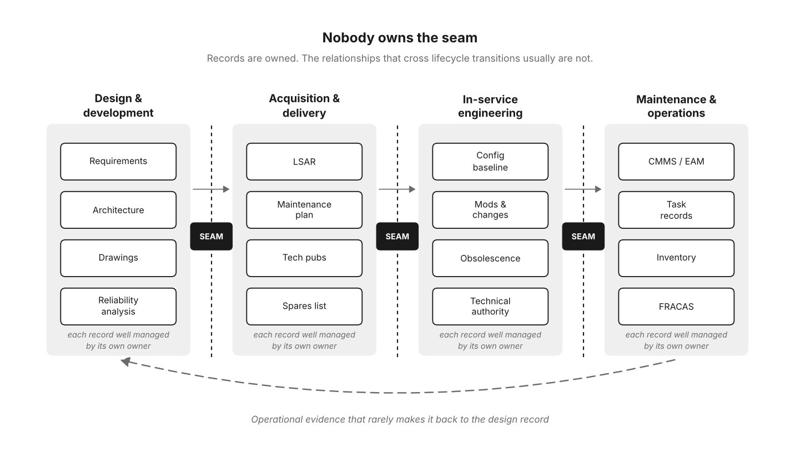
Within each boundary, the decision was sound. The difficulty is that reliability is not determined within any single boundary. It is determined by the combined effect of decisions across all of them.
This is where reliability exposure becomes a governance problem. If no one is responsible for the cumulative effect of accepted trade-offs, then no one sees it build up. Each new decision is assessed against the system as originally designed, not against the system as it has actually become after earlier concessions. Risk that would be rejected if presented all at once is accepted in small pieces.
Making Reliability Exposure Visible at the Decision Point
The answer is not to stop organisations making trade-offs. It is to make the reliability consequences of trade-offs visible when they are made, and to assign responsibility for their cumulative effect. In practice, that means:
- Requiring a reliability impact statement for decisions that reduce testing, defer maintenance, substitute components or change utilisation, however brief.
- Matching risk acceptance to authority. Technical risk should be accepted by someone with the technical authority and the accountability to do so, not absorbed as a by-product of a schedule or commercial decision.
- Keeping a register of accepted concessions, so that each new trade-off is judged against the accumulated exposure, not against the original baseline.
- Tracking actual utilisation and operating conditions against the assumptions used in reliability prediction, and triggering reassessment when they diverge.
- Extending failure investigations upstream, so that FRACAS and root cause analysis identify the decision pathways behind a failure, not only the physical mechanism.
None of these require new engineering methods. They require that the evidence reliability engineers already produce is linked to the decisions that actually shape reliability.
Reliability Is Decided Before It Is Measured
When equipment fails, it is natural to focus on the component. It is visible, physical and fixable.
But the component is often where the consequences of earlier decisions finally show up. The schedule, the test program, the deferral, the substitution and the increased tempo all left their mark long before the failure was recorded.
Organisations that want better reliability outcomes need to look beyond the failed part, to the decisions that set its operating conditions.
Reliability is measured in service.
It is decided much earlier, often in rooms where no reliability engineer was present.
Aerion Engineering Advisory
Aerion Engineering Advisory helps organisations understand how engineering, management and operational decisions shape reliability across the system lifecycle.
Our approach connects RAM analysis, FMEA/FMECA, RCM, FRACAS and root cause investigation with the governance and decision processes that determine reliability exposure, helping organisations identify where risk is being built in and how to address it before it shows up as failure.